





I remember the exact moment I stopped using bug spray.
It was a humid July evening. We were sitting on the patio, the grill was cooling down, and the mosquitoes were beginning their nightly assault. I reached for the familiar aerosol can — the one with the bright orange cap — and began spraying my seven-year-old daughter's legs.
The smell hit me first. That sharp, acrid, undeniable scent of a chemical laboratory. Then I actually stopped to read the warning label on the back of the can for the first time: "Do not apply over cuts, wounds, or irritated skin. Do not apply near eyes and mouth. Wash treated skin with soap and water after returning indoors."
I was coating my child in a registered pesticide just so we could sit in our own backyard.
"For a long time, the conversation about summer pest control has been built around one word: DEET. Invented in 1944 for jungle warfare, it became the undisputed king of insect repellents. We accepted the greasy residue, the chemical stench, and the quiet anxiety — because we believed it was the only thing that worked. We were wrong."
The Chemical Burden We Were Never Meant to Carry

The logic of DEET made sense in the 1940s. Push back the wilderness with superior chemistry. And for decades, it worked — at least on the mosquitoes.
But what has changed isn't the mosquitoes. It is our understanding of the human body. The skin is not an impermeable armor; it is a sponge. The Centers for Disease Control and Prevention (CDC) confirms that DEET is absorbed through the skin and enters the bloodstream. Studies have detected the chemical and its metabolites in the liver, kidneys, lungs, and brain.
- DEET is absorbed through the skin and enters the bloodstream — confirmed by the CDC/ATSDR
- DEET metabolites have been detected in the liver, kidneys, lungs, brain, and fat tissue
- Blood levels plateau 1.5 hours after application and remain elevated for 24 hours
- Adverse effects reported include seizures, uncoordinated movements, agitation, and low blood pressure
- A Swedish study found workers using DEET for 115+ days had an elevated risk of testicular cancer
- DEET has been found in streams, groundwater, and sewage treatment plants across the United States
We are currently living in an era of unprecedented chemical exposure. A 2024 study out of UC Berkeley identified over 900 chemicals in our everyday environment that may promote cancer development. The average adult carries hundreds of synthetic compounds in their blood at any given moment. The shift that helped me most wasn't finding a "milder" bug spray. It was stopping the deliberate application of pesticides to my family's skin entirely.
The Ancestral Shield We Forgot

Most "natural" pest control is sold on the idea that natural is automatically weaker. That you have to choose between safety and effectiveness. That is a modern myth — and it is a myth that has been extraordinarily profitable for the chemical industry.
For ten thousand years before DEET existed, humans lived alongside mosquitoes. They did not survive by swatting. They survived by understanding the volatile oils of the plants around them.
- Ancient Egyptians (2000+ BCE) burned castor oil and aromatic herbs to repel mosquitoes and flies
- Ancient Greeks burned Thyme in their temples — the word "thyme" derives from the Greek word for "smoke"
- Native Americans used smudge fires of cedar, sage, and sweetgrass to clear their living spaces
- Medieval Europeans hung bundles of Lavender and Thyme in doorways to repel insects
- Roman soldiers burned Rosemary in their camps — the plant's camphor content is a natural insect deterrent
- DEET was invented in 1944 for US Army jungle warfare. It is only 80 years old.
They knew something we forgot: certain botanical compounds are fiercely defensive. Plants cannot run from predators, so they evolved chemical warfare of their own. When we harness those raw, dried herbs and gently heat them, we are deploying nature's oldest shield.
The Nepetalactone Revelation

Science is finally catching up to the ancient apothecary. In 2001, researchers at Iowa State University made a startling discovery about a humble garden herb: Catnip.
They isolated the active compound in catnip, called nepetalactone, and tested it against Aedes aegypti — the yellow fever mosquito, the same species responsible for transmitting dengue, Zika, and chikungunya. The results shocked the entomology world.
A plant that grows wild in backyards is exponentially more powerful than the synthetic chemical we have been manufacturing in factories for eighty years. In Peterson's laboratory tests, catnip achieved a repellency rating of +49% to +59% — while DEET at the same concentration achieved only +10%.
When combined with the purifying camphor of Rosemary, the potent thymol of Thyme, and the linalool of Lavender, it creates an impenetrable botanical barrier. Not because of any single compound, but because of the synergistic complexity of nature itself.
The Ritual of the Burner

For most of my adult life, I measured summer evenings by the smell of bug spray and the sticky feeling on my arms. The shift that quietly changed everything was when I stopped spraying my skin and started scenting my space.
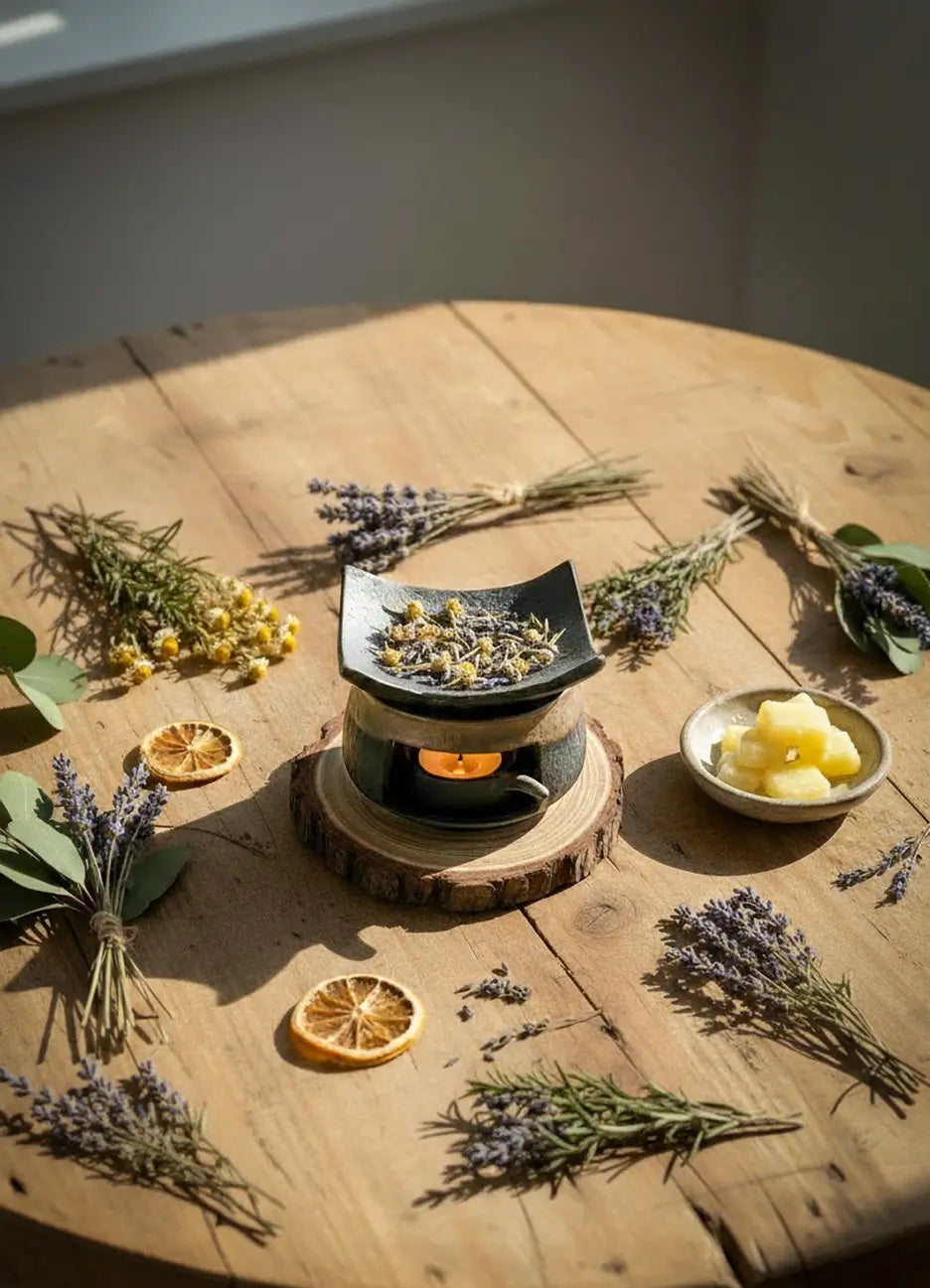
The mechanism is completely analog. A tealight candle placed under a ceramic burner. Raw, dried herbs placed on top. The gentle heat slowly roasts the botanicals — catnip, rosemary, thyme, and lavender — releasing their pure, natural volatile oils into the air without burning them to ash.
Within ten minutes, the botanical compounds fill the patio. The mosquitoes vanish. Not because they are poisoned, but because their sensory receptors are overwhelmed by the ancient botanical barrier. You put nothing on your skin. You spray nothing into the air. You simply light a candle and let the earth do what it has always done.
The Natural Barrier Bundle
Aromatherapy Kit + Botanical Blend
Cedar & Zen's Natural Barrier Botanical Blend is a precisely formulated combination of four of nature's most potent insect-repelling botanicals. Paired with the handcrafted ceramic Aromatherapy Kit, it is the complete, chemical-free solution for summer evenings.
Safe around children and pets. No sprays, no aerosols, no skin contact required. Just raw botanical science, the way nature intended it.
Free shipping · 30-day money-back guarantee · Limited summer stock
A Return to the Garden
This transformation didn't require a prescription, a hazmat suit, or a laboratory. It happened because someone remembered how to use the earth.
That is what the modern chemical industry doesn't account for. They sell convenience in a can. But the people who are reclaiming their health are usually the ones who stop looking for shortcuts and start returning to the raw, physical benefits of nature. Not a synthetic imitation. The real thing.
The question I ask myself now is simple: if the ancient world protected itself with botanical fire for ten thousand years, and if modern science confirms that those botanicals are more effective than the chemicals we replaced them with — why are we still spraying pesticides on our children?
I don't have a good answer. But I do have a burner on my patio table, a bag of dried catnip, rosemary, thyme, and lavender, and the most peaceful summer evenings I can remember.


Kit + Blend · Free shipping · 30-day money-back guarantee


